Spoilers ahead

Key takeaways

The essential ideas from each of the nine chapters of Unstable Innovation, summarized by Adam Nili.

← Back to all insights

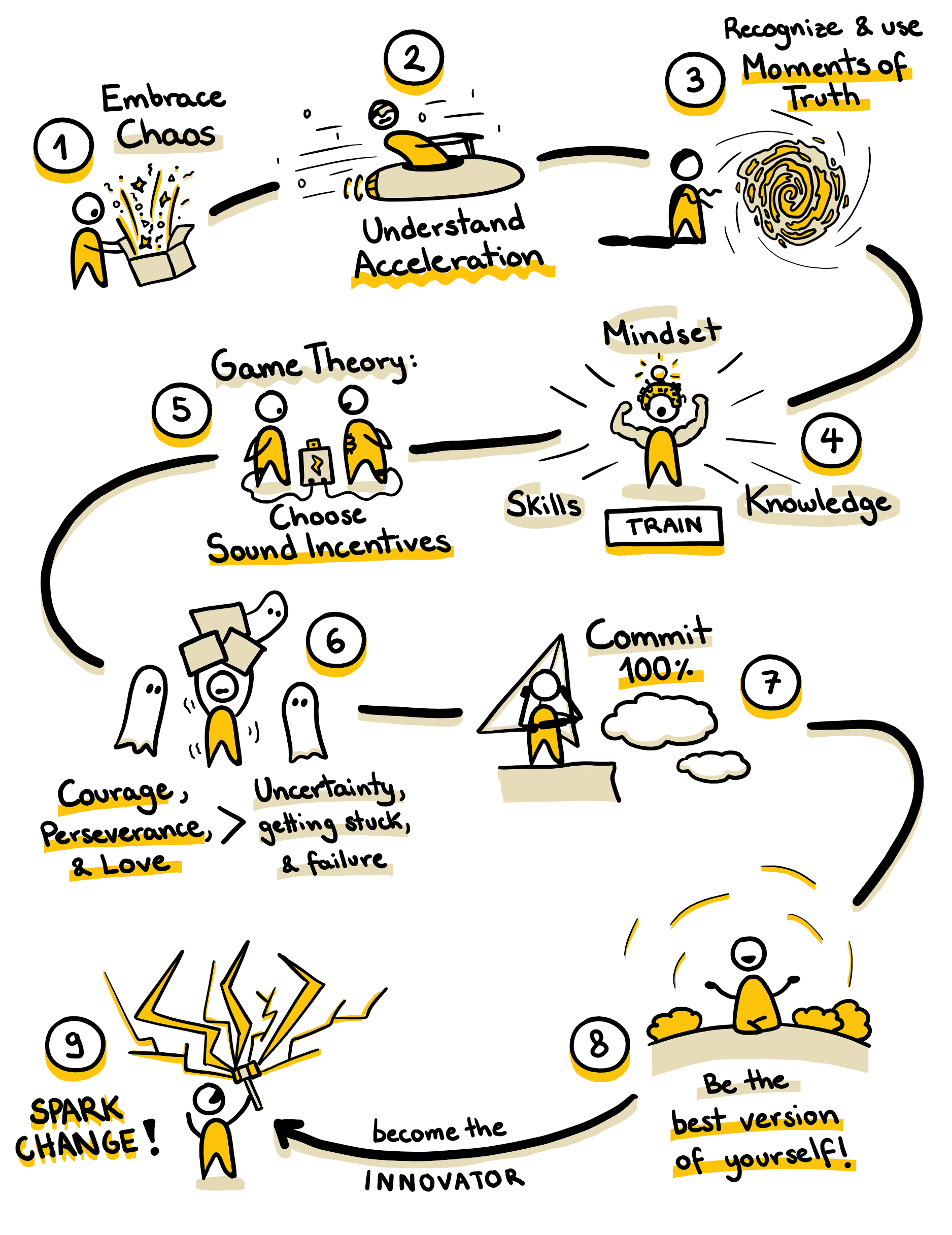
The Innovators Path visual roadmap of the 9 chapters of Unstable Innovation by Nelson Inno
Chapter 1

Innovation emerges from chaos

  • Innovation doesn't follow a straight path; it emerges from chaotic and seemingly random connections.
  • Synthesis — the process of combining unrelated ideas — is key to generating new innovations.
  • Creativity often feels unstructured and unpredictable, but it can be controlled and harnessed.
  • Accepting chaos is essential — innovation thrives in uncertainty and unpredictability.
  • While we can't always control the circumstances, we can train ourselves to navigate the chaos and recognize opportunities within it.
Chapter 2

Acceleration, not speed

  • Acceleration, rather than speed, is the force that drives rapid change in industries and innovation.
  • Technological advancements compound, creating a chain reaction of innovations that build upon each other.
  • The pace of innovation today is so fast that it often outpaces our ability to measure or fully comprehend it.
  • To succeed in the face of rapid acceleration, it's essential to stay informed and be ready to act on new opportunities as they arise.
  • Embracing and preparing for technological acceleration is crucial for staying competitive in today's market.
Chapter 3

Moments of truth

  • Life is full of uneven opportunities and challenges, and innovation is no different.
  • A "moment of truth" in innovation occurs when you face a critical decision that can drastically alter the course of your journey.
  • Wisdom and mindset, built through life's hardest lessons, are essential for navigating these moments successfully.
  • Recognizing and seizing your moment of truth can lead to breakthroughs, but this requires preparation, awareness, and action.
  • Innovators must be ready to act quickly when these moments arise, as hesitation can lead to missed opportunities.
Chapter 4

Mindset over framework

  • Innovation is more about mindset and human behavior than rigid structures or processes.
  • A purpose-driven mindset helps fuel creativity and perseverance through challenges.
  • Failure is a necessary part of the innovation process, offering valuable lessons.
  • Cultivating a state of mind that embraces creativity, failure, and continuous learning is essential for innovation.
  • If you want to become one with innovation, it helps to adopt the right mindset, gain relevant knowledge, and develop the necessary skills to build your dreams.
Chapter 5

Game theory & incentives

  • Game theory helps us understand strategic decision-making, especially when dealing with uncertainty.
  • Misaligned incentives and weak structures often lead to failure; solving these issues is key to innovation success.
  • The real-life application of game theory can guide innovators in making smarter decisions and anticipating competitors' moves.
  • Proper alignment of incentives leads to better collaboration and more robust innovation.
Chapter 6

The unavoidables

  • Certain challenges in innovation — uncertainty, failure, and getting stuck — are unavoidable.
  • Innovators must learn to navigate uncertainty by embracing flexibility and openness to change.
  • Resilience and the ability to bounce back from failure are key traits of successful innovators.
  • Accepting failure as part of the journey can turn obstacles into stepping stones for future success.
Chapter 7

Commitment

  • Full commitment is essential for success in innovation — half measures rarely lead to breakthroughs.
  • Innovators must be prepared to take calculated risks and stick to their vision, even when challenges arise.
  • Without commitment, great ideas remain unrealized and fail to create impact.
  • Truly understanding your field of business can be a serious competitive advantage.
  • The most extraordinary entrepreneurs do ordinary things for an extraordinary amount of time.
Chapter 8

Eudaimonia

  • Eudaimonia, or human flourishing, is a state of fulfillment that can be achieved through purposeful innovation.
  • True innovation goes beyond material success — it also brings personal and societal fulfillment.
  • Innovators who align their work with their deeper purpose are more likely to achieve long-term success and satisfaction.
  • We should aspire to be the best version of ourselves day to day.
Chapter 9

The spark

  • A "spark" of inspiration often ignites the innovative process, but it's up to the innovator to nurture and grow it.
  • The key to long-lasting innovation is to keep fueling the creative process with new ideas, experiences, and collaboration.
  • Innovators must stay curious and open to new opportunities to keep their spark alive.
  • While it might look like our world has too many significant problems to solve, millions of innovators are working hard every day to solve the most complex challenges of humankind.
  • An innovator can build extraordinary projects and create huge positive impact and stay humble at the same time.

Want the exercises too?

The takeaways tell you the idea. The practical applications give you the drill.

Practical applications →